
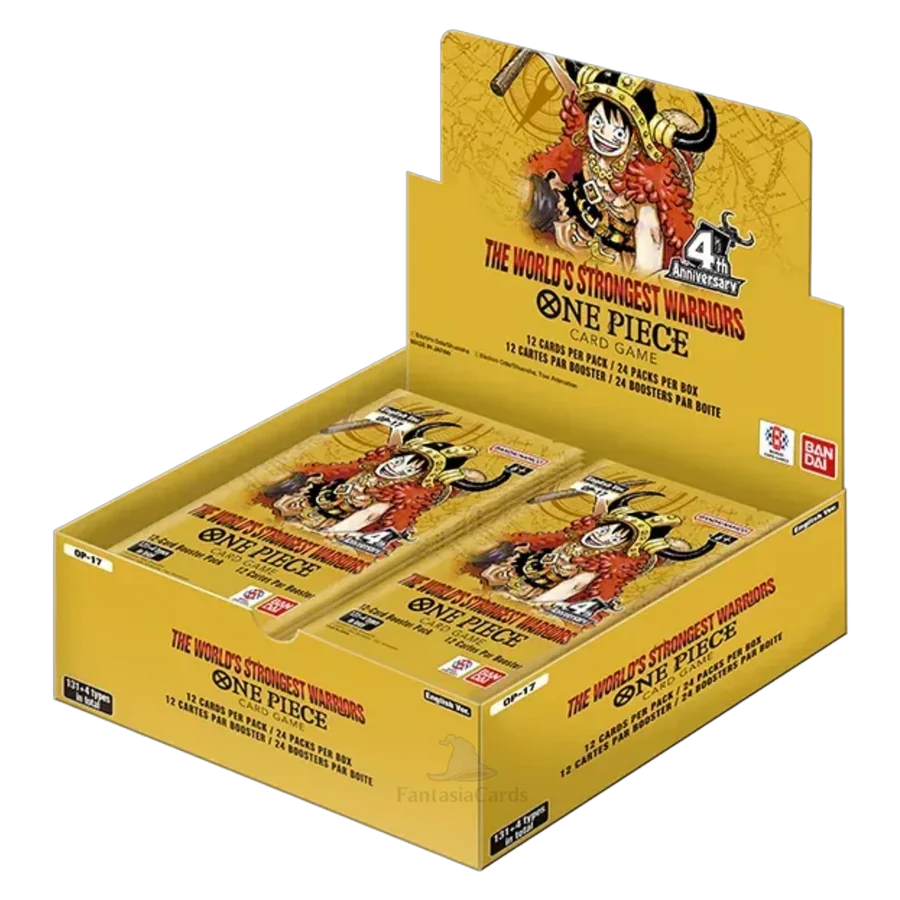
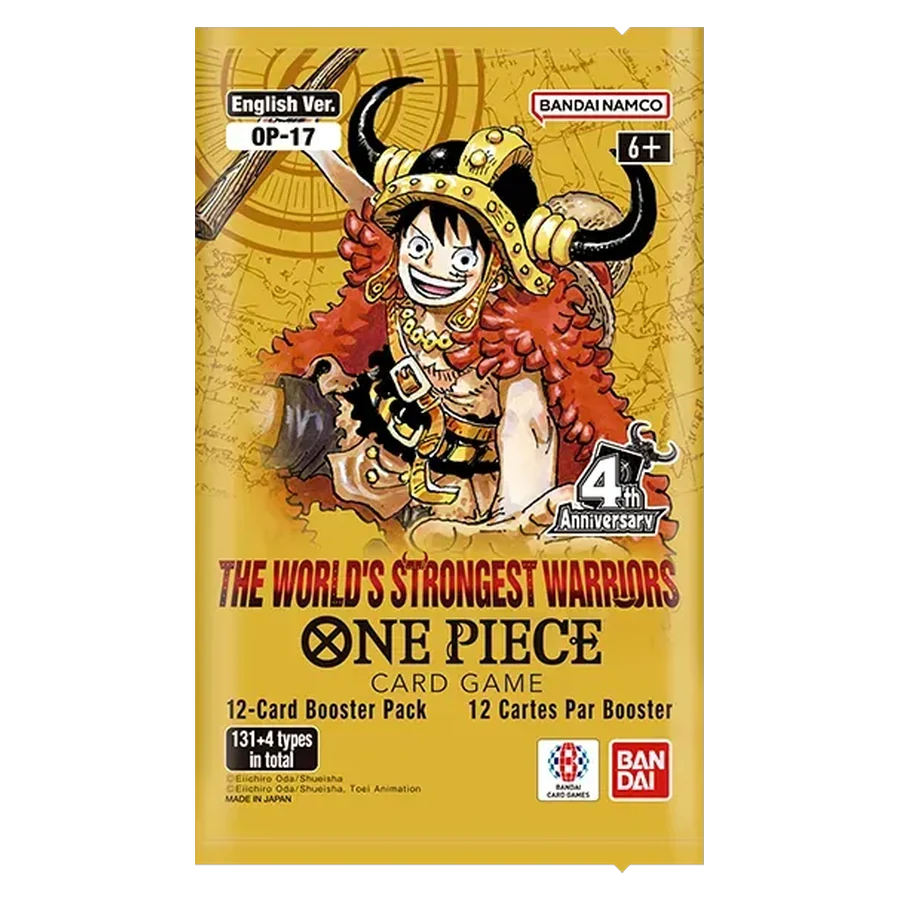
Luffy on Elbaph, the Rocks Pirates and the Emperors sharing the stage: OP-17 brings together several subjects One Piece fans are following closely. For the card game, another question is just as interesting. Which cards change how a deck develops, which support familiar plans, and which do you mainly want in your binder for their artwork?
The World's Strongest Warriors is already released. Bandai lists 28 August 2026 as the English release date and states 131 plus four card types. This article is researched as of 7 October 2026. OP-17 is therefore among the latest regular main sets, with OP-18 announced for 20 November on the official product overview. Bandai’s OP-17 product page and current booster overview
This set review looks at confirmed contents and selected deck ideas. It explains what to consider when building a deck or collection. It does not establish a competitive ranking: an interesting effect and a successful tournament deck are different questions.
Elbaph and Rocks give the set two clear themes
The official product page puts the Straw Hats in their Elbaph outfits and the Rocks Pirates at the centre. Special variants involving the Emperors and the card game’s fourth anniversary appear alongside them. Bandai also presents a Super Leader Alt-Art version of Monkey.D.Luffy OP17-079 featuring manga artwork. Bandai: OP-17 themes and special variants
Collectors can take this in several directions. You might follow the Straw Hat illustrations, build a Rocks-focused collection or concentrate on individual favourite characters. That is more useful for purchasing than a general intention to own as many rare cards as possible. A collection with defined boundaries is easier to complete deliberately.
Players should look at those themes a second time. A shared crew type can matter for searches and other conditions. Two cards with matching illustrations still do not automatically work together. Colour, cost and effect requirements determine whether they can perform useful jobs in the same list.
Six Leaders offer six starting points
Bandai presents set-related deck ideas for red Edward.Newgate, green Shanks, blue Rocks.D.Xebec, purple Kaido, black Monkey.D.Luffy and yellow Charlotte Linlin. These official examples outline intended directions, including attacks against rested Characters, DON!! use for expensive Characters and Trigger-based play. Bandai: OP-17 recommended decks
Choosing a Leader is therefore a practical first step into the set. Pick an approach you actually want to try. If you enjoy planning several turns ahead and preparing a later position, you will look for different cards than a player who wants to establish attack after attack as early as possible.
Then read the example cards together. Which helps the opening? Which turns your setup into a threat? Which protects that setup? A list full of individually impressive cards can still stall if the connection between those jobs is missing.
Black Luffy uses high cost as a shared condition
Monkey.D.Luffy OP17-079 gives your Characters with a cost of at least twelve Blocker. At first that sounds like a plan that would start far too late. Bandai’s deck feature explains the connection with Giants whose cost increases by twelve on the field. They can reach the requirement without you paying twelve DON!! to play them. Bandai: black Luffy and Giants
The shared condition is the interesting deck-building point. You want to reach suitable Giants on time and play other cards that benefit from their presence. A hand full of supporting pieces can disappoint when the foundation is missing. During testing, watch how often your position sits idle without the required high-cost Character.
Loki OP17-119 fits this idea. Bandai highlights his cost increase and additional power during the opponent’s turn. Together with the Leader, he becomes a substantial defensive Character. Bandai: Loki’s role in the Luffy deck
That gives you a concrete turn-planning question. A Character meant to block later must be available for that task. When attacking, already consider how you will survive the opponent’s reply. Test both positions: one with protection prepared, and another where your board can barely defend after attacking. The difference shows what the card contributes in practice.
Rocks.D.Xebec needs the right hand behind him
Rocks.D.Xebec OP17-118 is a blue Character with ten cost and 12,000 power. His On Play effect draws one card and allows up to two Rocks Pirates cards with different names and a combined cost of nine or less to be played from your hand. Another condition can give him a 2,000 Counter while in hand: all your Characters in play must be without a Counter. Bandai: official OP-17 card list
You can calculate potential follow-ups when building the deck. Costs of four and five, or three and six, are possible combinations if the selected cards meet the other requirements. Two suitable cards with the same name do not fulfil that condition. A full trash does not replace the hand cards the effect asks for either.
Testing should therefore include a question that is easy to overlook with large finishers: what do I keep back before the big card arrives? Playing every useful supporting piece earlier can leave the later effect with less to do. Holding too much back may leave you without an early board. That tension makes the card interesting and demands more than simply reaching ten DON!!.
Try two sequences with the same hand. Play the supporting card early in one and save it for the later setup in the other. Observe whether you can reach that later turn safely at all. A potentially powerful effect belongs in your game plan only if the game lasts long enough to use it.
Judge cards by their contribution
You do not need to assemble every new deck in full to test OP-17. Start with a specific question about your existing list. Are you short of cards? Do you lose against several small attackers? Is your hand regularly full of cards that only become useful much later?
Look for a card that could actually address that problem. A matching crew type or attractive rarity is not a sufficient reason. You want to know when the card will be played, what resources it needs and which existing card will make room for it.
Before changing the list, write down what should improve. For example: “I want to prepare an additional Character more often during the middle turns.” After several games, check whether that happened. If the new card only looks impressive in positions you were already winning, it may not have filled the original gap.
Evaluate artwork and play value separately
A special illustration can make a card the centrepiece of your collection. For your deck, check its text and card number. When choosing between different versions, compare the actual variants carefully. Similar names alone do not guarantee that you are looking at the same playable card.
Separating those priorities makes purchasing easier. To play, you need the right number of copies of a suitable card. For your binder, you may want exactly one artwork in a particular condition. Both are reasonable goals, but they produce different shopping lists.
If your budget is limited, keep those lists separate. You can then see whether you are filling a deck slot or treating yourself to a collectible. An expensive favourite illustration can be enjoyable without improving your tournament list. You do not need to justify it with an imagined gameplay advantage.
Display, booster or a particular card?
A display gives you multiple openings from one set. Individual boosters suit a smaller opening session or a first look at the set. For a specific deck, the important question remains which cards you need and how many copies of each.
Calculate against your actual goal before buying. If you need four copies of a particular card, random booster contents are not a reliable substitute for that list. If you want to discover artwork and open packs together, on the other hand, surprise is part of the experience you are choosing.
Bandai notes that duplicate cards may occur and that completing a whole set may be difficult. The opened contents are random. Bandai: pack contents and product notes
Do not turn someone else’s opening into a guarantee of a particular hit. Their result shows what was in those packs. It does not establish what will be in yours. This article therefore gives no claimed pull rates or fixed number of special hits per display.
Compare offers with matching details
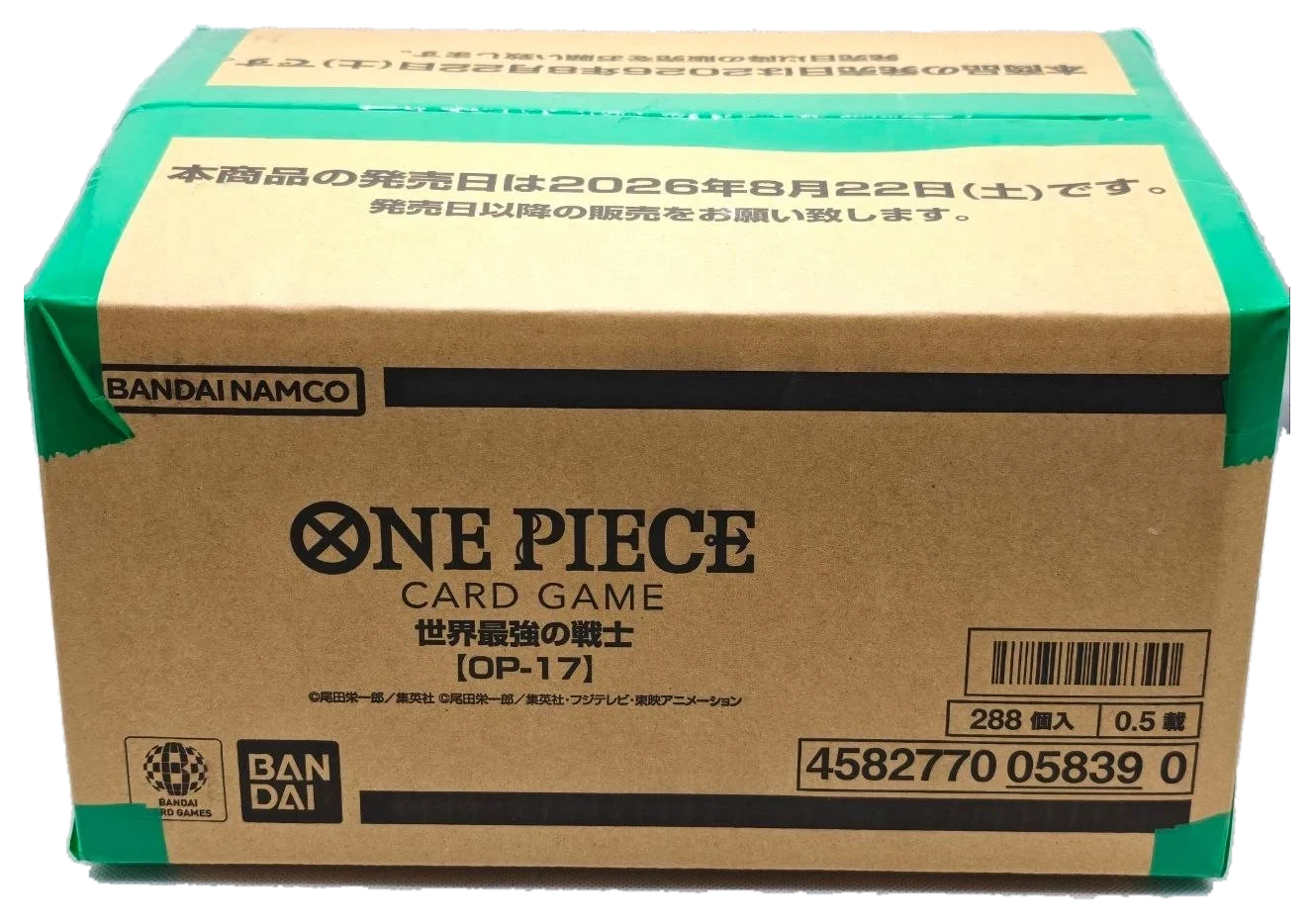
Before comparing prices, check language, product type and quantity. One booster, a display and a case are different offers. Having OP-17 in every title does not make them directly comparable. Check that the photograph also matches the edition being offered.
For singles, compare card number, variant and condition. A cheaper copy might feature different artwork or more wear. That may be a good choice for playing and a less suitable choice for your collection. Decide which properties matter to you before comparing the price.
GrandLine Market has catalogue entries for OP-17 displays and OP-17 boosters. The respective product page shows whether a purchasable offer is currently available. A catalogue entry by itself is not a statement about present stock.
GrandLine Market also lists the OP-17 case with Japanese cards. A case contains multiple displays; check the exact unit offered on the product page.
Who should take a closer look at OP-17?
If you want to collect the Elbaph Straw Hats or Rocks Pirates, the set offers a clear thematic direction. If you are looking for a new deck idea, the official Leader features are a useful starting point. Luffy’s cost conditions and Rocks’ setup from hand provide specific sequences you can investigate at the table.
Use a simple test question: how reliably can I reach the cards that enable my key turn? Then play hands where one part is missing as well. Those games reveal whether you enjoy the approach and whether the list has enough alternatives.
If you first want to improve your turn planning, the One Piece game guide covers the foundations. Save your list in the deck builder, then compare individual changes after your test games.
OP-17 gives you enough material for a specific choice. Pick a Leader or collecting theme, work out the cards you want, and decide which product fits. That leaves you with more than a search for the next rare hit: a collection with direction or a deck whose setup you understand.
Find the right product
The World’s Strongest Warriors: choose a case, a display or individual boosters. The product page shows the card language and current offers.